
1. Introduction
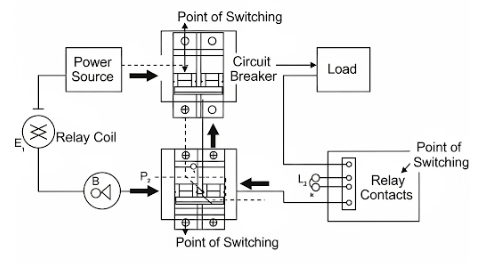
The point of switching in a circuit breaker refers to the exact instant in time when the breaker contacts open or close, interrupting or establishing the current path. This is a critical parameter in power system operation, as it influences transient behavior, arc formation, switching overvoltages, and equipment life. Understanding the concept is essential for safe and efficient switching in high-voltage (HV), medium-voltage (MV), and low-voltage (LV) systems.
2. Definition of Point of Switching
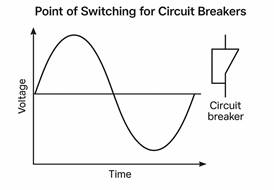
In electrical engineering, the point of switching is defined by the breaker’s mechanical and electrical characteristics. Electrically, it is the moment when the current flow is interrupted or established. Mechanically, it is linked to the movement of the breaker’s contacts and operating mechanism. For AC systems, this point may coincide with a particular phase angle of the voltage or current waveform.
3. Types of Switching Points
The point of switching can be classified into:
• Current Zero Switching – occurs when the current naturally passes through zero in AC systems.
• Pre-insertion Resistor Switching – controlled closing at a specific voltage phase to minimize transients.
• Synchronous Switching – operation synchronized with waveform to reduce switching surges.
• Random Switching – breaker operation at arbitrary points in the waveform.
4. Breaker Operation & Timing
The point of switching depends on the operating time of the breaker mechanism, which is typically in the range of 30–80 ms for HV breakers. Opening and closing times must be coordinated with system requirements. Modern breakers use control electronics to achieve accurate switching instants.
5. Electrical Considerations
Key electrical factors affecting the point of switching include:
• System frequency and waveform shape.
• Magnitude and phase of load current.
• Presence of inductive or capacitive components.
• Transient recovery voltage (TRV) characteristics.
• Pre-strike and re-strike phenomena.
6. Arc Phenomena at Switching
When the breaker contacts separate, an electrical arc forms, sustaining current until the natural current zero in AC or until the arc is quenched in DC. The point of switching impacts arc duration, energy, and contact wear. SF6 gas, vacuum, and air blast technologies each manage arc extinction differently.
7. Applications in HV and MV Systems
In HV and MV networks, controlled point-on-wave switching is used for:
• Energizing unloaded transformers.
• Switching capacitor banks.
• Closing long transmission lines.
• Reducing inrush currents and overvoltages.
8. Standards and Testing
IEC 62271 and IEEE C37 standards define performance criteria for point-on-wave switching. Testing involves measuring the breaker’s operating time, phase synchronization accuracy, and TRV withstand capability.
9. Measurement and Analysis
High-speed oscillographic recording is used to determine the exact point of switching in laboratory and field conditions. Digital fault recorders (DFRs) and breaker monitoring systems provide real-time analysis for maintenance and diagnostics.
10. Common Issues & Troubleshooting
Problems related to point of switching include:
• High inrush currents due to unsynchronized closing.
• Overvoltages from switching at voltage peaks.
• Contact wear from repeated arcing.
• Failure of control circuits leading to mistimed operations.
11. Advances in Switching Technology
Recent developments include microprocessor-based point-on-wave controllers, adaptive algorithms for varying system conditions, and integration with smart grid systems for automated switching optimization.
12. Conclusion
The point of switching is a key factor in circuit breaker performance, influencing both system stability and equipment longevity. Through careful design, synchronization, and monitoring, engineers can minimize adverse switching effects and enhance operational reliability.